Orange is the New Pink this Breast Cancer Awareness Month | Physicians Committee

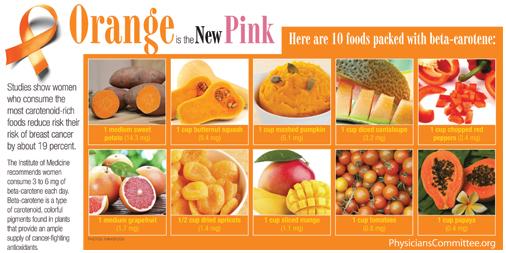
Women across the country should swap their pink ribbons for orange vegetables this Breast Cancer Awareness Month if they really want to improve their odds of fighting the disease that kills tens of thousands of women each year.

The latest research shows that women who consume the most carotenoid-rich fruits and vegetables reduce their risk for breast cancer by about 19 percent, according to Susan Levin, M.S., R.D., director of nutrition education for the Physicians Committee and author of Applying the Precautionary Principle to Nutrition and Cancer guidelines, which was published in the Journal of American College of Nutrition. Carotenoids are colorful pigments found in plants that provide an ample supply of cancer-fighting antioxidants.

Continued:

Orange is the New Pink this Breast Cancer Awareness Month | PhysiciansCommittee.

View image on Twitter

My 30-Day Burger Experiment: Real vs. Fake Foods – YouTube

My 30 Day Burger Experiment! Are you eating REAL FOOD or FAKE FOOD? What is the difference between FullyRaw foods and processed foods? See these shocking results after I kept a burger in my garage for 30 days.


Dean Ornish, MD: Discussed the Struggle to Get the Message Out | Dr. McDougall’s Health & Medical Center

Dean Ornish, MD, is the founder and president of the non-profit Preventive Medicine Research Institute and Clinical Professor of Medicine at the University of California, San Francisco.

via Dean Ornish, MD: Discussed the Struggle to Get the Message Out | Dr. McDougall’s Health & Medical Center.

Does falling smoking lead to rising obesity? Journal of Health Economics

Abstract


The strong negative correlation over time between smoking rates and obesity have led some to suggest that reduced smoking is increasing weight gain in the U.S. This conclusion is supported by the findings of Chou et al. [Chou, S.-Y., Grossman, M., Saffer, H., 2004. An economic analysis of adult obesity: results from the behavioral risk factor surveillance system. Journal of Health Economics 23, 565–587], who conclude that higher cigarette prices lead to increased body weight. We investigate this issue and find no evidence that reduced smoking leads to weight gain. Using the cigarette tax rather than the cigarette price and controlling for non-linear time effects, we find a negative effect of cigarette taxes on body weight, implying that reduced smoking leads to lower body weights. Yet our results, as well as Chou et al., imply implausibly large effects of smoking on body weight. Thus, we cannot confirm that falling smoking leads in a major way to rising obesity rates in the U.S. © 2005 Elsevier B.V. All rights reserved.

http://www.cnn.com/2009/HEALTH/12/03/obesity.smoking.lifespan/

Pick an article from a Google search: https://www.google.com/search?q=how+obesity+has+risen+since+smoking+lowered&oq=how+obesity+has+risen+since+smoking+lowered&aqs=chrome..69i57.12655j0j7&sourceid=chrome&es_sm=0&ie=UTF-8#q=how+obesity+has+risen+since+smoking+lowered+journal+of+health+economics

Interesting to consider.

21-Day Vegan Challenge | Yoga Journal

A plant-based diet may be the secret to increased energy, better health, saving our planet, and becoming a more enlightened yogi. Here’s your roadmap for taking veganism for a test drive.

Ask the most well-respected nutrition researchers what the healthiest way to eat is, and they’ll give you a simple answer: unprocessed food, mostly plants. “All the research points to a plant-based diet—for your health and for the planet,” says David Katz, MD, director of Yale University’s Prevention Research Center and a leading expert on nutrition and health. Numerous studies show eating zero animal protein or significantly cutting back to only a few times a week, for example can help lower your risk for diabetes, heart disease, obesity, and cancer. “DNA does not determine your medical destiny—dinner does,” he says.

If that dinner includes meat and dairy, it may not be inherently unhealthy—a growing body of evidence suggests their saturated fat might not be as harmful as once thought. Nonetheless, plants are exponentially healthier, says Philip Tuso, MD, a plant-based nutrition expert with Kaiser Permanente Care Management Institute. “All the extra fiber, vitamins, minerals, antioxidants, and other phytonutrients you take in by swapping meat for plants have a healing and protective effect,” he says. In fact, eating a mostly vegan diet may even change the way your body reacts to meat if and when you do eat it: Studies suggest that when people who usually follow plant-based diets consume meat, their bodies don’t produce the same amounts of a chemical associated with heart disease, called TMAO, as omnivores’ bodies do.

The cost of the typical American diet goes beyond increased illness and subsequent health care dollars, however. It requires more than 1o times the energy, plus about 1oo times more water, to produce the same amount of meat protein as plant protein, according to studies on the true cost of farming. Mounting evidence suggests that every step of meat production, from feeding animals to processing meat, depletes resources, stressing an already- fragile environment. “Even if you could be healthy on an animal-based diet, it would be hard on a planet without enough water,” Katz says.

Here’s the thing: You don’t have to go hardcore vegan to reap a large helping of the environmental or health benefits, experts say. The key is to simply eat less beef, poultry, pork, fish, eggs, and dairy, and make the majority of your food plants, including plant-based proteins, such as beans and nuts, says Sharon Palmer, RD, author of Plant-Powered for Life and creator of our vegan meal plan. How you do that is up to you. Perhaps you have vegan days or weeks, eat vegan before 6 p.m. an idea promoted by The New York Times food columnist and cookbook author Mark Bittman, or follow a true Mediterranean diet, in which meat plays a small role. Whatever you choose, you’ll feel the difference almost immediately. “People who eat unprocessed, whole food and mostly plants have more energy. They feel better, they’re healthier, so they’re happier,” Katz says.

Why not see for yourself? Take our three-week vegan challenge, starting with the tasty and healthy recipes and tips on the following pages, then register online for more free recipes and support. For the full 21-day menu, sign up for our newsletters here. Whether you do it for a day, a week, 21 days, or forever, the proof will be in the dairy-free pudding.

See also 3 Ways Going Vegan Reduces Your Carbon Foot Print

via 21-Day Vegan Challenge | Yoga Journal.
No Bitter Pill: Doctors Prescribe Fruits And Veggies : The Salt : NPR

Ron Samascott with his local apples at the Union Square Greenmarket in New York. The city is teaming up with Wholesome Wave, hospitals and farm markets to pilot a fruit and vegetable prescription program.

Ron Samascott with his local apples at the Union Square Greenmarket in New York.

The city is teaming up with Wholesome Wave, hospitals and farm markets to pilot a fruit and vegetable prescription program .Mark Lennihan/AP

It was the Greeks who first counseled to let food be thy medicine. And, it seems, some doctors are taking this age-old advice to heart.

Continued:

via No Bitter Pill: Doctors Prescribe Fruits And Veggies : The Salt : NPR.

How to Face Discomfort in the Body – Rupert Spira

Published on May 27, 2014

In this video clip, Rupert discusses one way to approach habitual experience of discomfort in the body arising from the sense of separation.

Tom Campbell México City 2013 Part 5 – YouTube

Published on Oct 2, 2014

From November 2013 – Expand your Consciousness Workshop in Mexico City hosted by Dr Diana Morales. Thomas Campbell is the author of the trilogy, My Big TOE My Big Theory of Everything. In this work, Tom presents his Theory on the properties, boundaries, and abilities of Consciousness, which derive from thirty years of his personal and scientific exploration.With words and concepts that everyone can easily comprehend, Tom gives us a new understanding of Consciousness that we can integrate into our personal and professional lives.Tom explores and discusses:How we can evolve the quality of our Consciousness.How fear and ego keep us from becoming love.How beliefs limit our understanding of the larger reality.How we can improve the quality of our daily existence, interact more productively with others, co-create our own reality, and much more …

via Tom Campbell México City 2013 Part 5 – YouTube.

Ebola in the United States: Everything You Need To Know! – YouTube

Stefan Molyneux breaks down the latest news information on the first documented case of Ebola in the United States. Thomas Eric Duncan was infected in Liberia and recently traveled to Dallas, Texas where he began exhibiting symptoms of infection.