Daily Archives: May 29, 2020
DOES AMERICA WANT TO OPEN UP?
As some American fight to stay in their Covid bubble, many are taking to their state capitols to protect their constitutional rights. We went to the “Texas Freedom Rally” in Austin to see what people think about opening up America, and speak to a “Generation Z” activist & mom, on what it’s like to fight for her child’s future.
#TexasFreedomRally #GenerationZ #BeBrave #OpenAmerica #AloneTogether ?
Italy: 96% of Coronavirus Fatalities Had Other Chronic Illnesses – Breitbart

The overwhelming majority of deaths with coronavirus in Italy have occurred in the presence of two or more serious chronic illnesses, according to a report from the country’s national health authority (ISS).
Italian health authorities announced in a recent report that only 4.1 percent of fatalities testing positive for Wuhan coronavirus happened in the absence of serious comorbidities, while the average age of the deceased was over 80 years.
The average number of comorbidities among all Italian deaths with the coronavirus was 3.1, ISS revealed. Just 15 percent of fatalities occurred with the presence of just one other serious pathology, while 21.4 percent died with two other pathologies, and 59.6 percent with three or more pathologies.
The most common comorbidities were arterial hypertension (in 68.3 percent of cases), type-2 diabetes (30.1 percent of cases), ischemic heart disease (in 28.2 percent), atrial fibrillation (22.5 percent), chronic renal failure (20.4 percent).
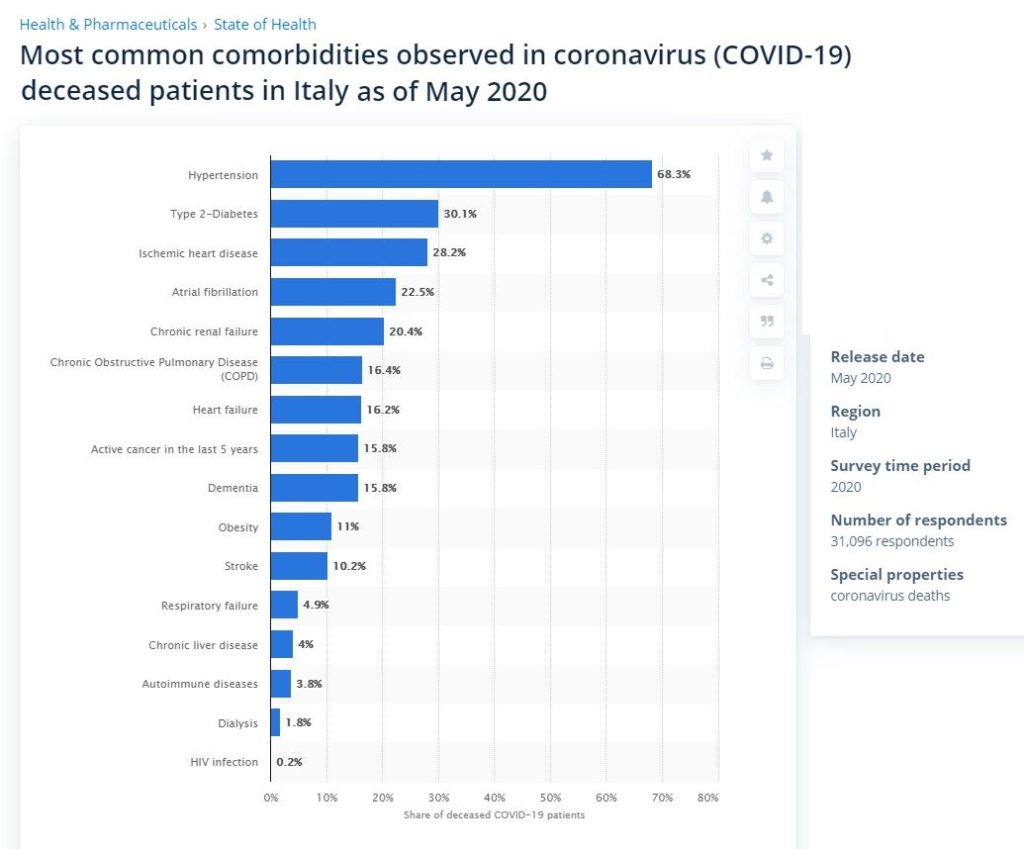
Most common comorbidities among Italy deaths with coronavirus.
The report also revealed an average age of 81 among those who have died with coronavirus in Italy. One of the most astonishing findings of the report was that only 1.1 percent of all coronavirus deaths in the country happened to people below the age of 50, while more than 57 percent were over 80.
“The latest numbers show that new cases and fatalities have a common profile: mostly elderly people with previous illnesses,” said ISS president Silvio Brusaferro at a news conference Friday.
As of May 26, the number of active cases of coronavirus in Italy had fallen to 52,942. The total number of deaths with the disease have been 32,955, while total recorded cases stands at 230,555.
This week Spain had to revise down its official death count for the coronavirus by nearly 2,000 after discovering a series of reporting errors and duplications.
The Spanish Health Ministry announced Monday that it removed 1,918 spurious deaths from the official death toll, representing a seven percent drop in the total deaths reported.
Source: Italy: 96% of Coronavirus Fatalities Had Other Chronic Illnesses
Quarantine vs Tyranny
‘Quarantine’ is when you restrict the movement of sick people.
‘Tyranny’ is when you restrict the movement of healthy people.
Q
Newsweek – Fri, May 29, 2020: Japan Ends Coronavirus Emergency With 850 Deaths and No Lockdown
https://www.newsweek.com/japan-ends-coronavirus-emergency-850-deaths-no-lockdown-1506336
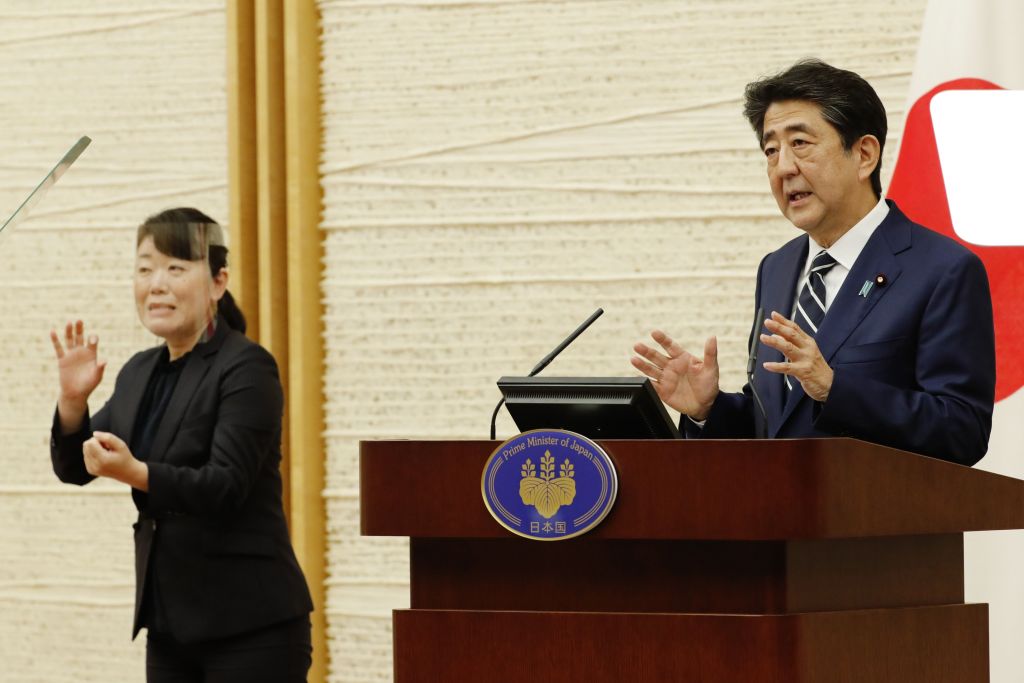
Japan’s Prime Minister Shinzo Abe has announced the end of his state of emergency declaration for the novel coronavirus pandemic, with just 851 deaths reported and without ever implementing a lockdown.
“I have decided to end the state of emergency across the nation,” Abe said during a televised press conference on Monday. “In just over a month and a half, we almost brought (the infection) situation under control.”
Abe cautioned that lifting the order did not mean that the novel virus was gone from Japan. “Our battle against the virus will continue,” he said, while urging the Japanese people to continue following stringent social distancing guidance.
As of Monday, the East Asian nation had reported 16,628 confirmed cases of the novel coronavirus. Of those infected, 13,612 have already recovered and 851 have died. Tokyo, the nation’s capital with 14 million residents, was the hardest-hit part of the country, with more than 5,100 cases. On Monday, the city reported just eight new infections.

A spokesperson from the Japanese embassy in Washington, D.C. told Newsweek that the country would continue to monitor the spread of the virus and maintain restrictions on international travelers for the foreseeable future.
“The spread of COVID-19 is changing from moment to moment and it is challenging to predict confidently. However, Japan is to carefully consider how to ease its restrictions on international travels partially and gradually while keeping to contain COVID-19,” the spokesperson explained in an email.
While Japan never implemented stringent lockdowns like those in parts of China, many European countries and the U.S., it barred foreigner travelers who had recently visited many hard-hit countries and urged residents to adhere to social distancing guidelines. Restaurants and shops were also required to close earlier than normal. Karaoke bars, live music venues and gyms were shuttered and will remain closed in the coming weeks.
Public health officials in Japan have warned the population to wear masks in public and continue to work from home if possible. The Japanese government has asked the population to adapt to a new lifestyle to avoid an uptick in new cases and prevent the spread of the virus. People have also been encouraged to avoid traveling for non-essential purposes to other regions of the country.
It’s unclear why Japan has a relatively low infection rate and a comparatively small number of deaths due to COVID-19. Abe has faced criticism for taking little action to curb the virus’ spread as many other nations implemented stringent lockdowns.
“Just by looking at death numbers, you can say Japan was successful,” Mikihito Tanaka, a professor at Waseda University specializing in science communication, and a member of a public group of experts on the novel virus, told Bloomberg. “But even experts don’t know the reason.”
Yasutoshi Nishimura, Japan’s economic revitalization minister, has said that the situation with the virus will be reviewed every three weeks and further steps could be taken to ease the guidance currently in place, Kyodo News reported. Until then, the Japanese public has been encouraged to remain at home and to avoid large public gatherings.
This article has been updated with a comment from the Japanese embassy in Washington, D.C.
A tango in America’s future? Bill Bonner’s Diary by Rogue Economics
Friday, May 29, 2020 – Week 11 of the Quarantine
 |
SAN MARTIN, ARGENTINA – Yesterday, we saw how the feds are in the process of cronifying the American working class… by bribing the great mass of “average” voters who decide elections.
And here’s the latest from The Washington Post:
To help speed the delivery of up to $1,200 in economic impact payments to individuals made available under the $2 trillion Coronavirus Aid, Relief, and Economic Security (CARES) Act, the Treasury Department last week began mailing prepaid debit cards to 4 million Americans.
The prepaid debit cards allow recipients to make purchases online and at any retail location where Visa is accepted. Recipients can also receive cash from in-network ATMs and transfer funds to their personal bank accounts without a fee. (Fees may apply if an out-of-network ATM is used.)
Eric Green and his wife, who live in Arlington, Va., received a card in the mail last week. But they, like so many others, thought it was a con…
And they were right. But it is a much slicker con than they realized.
Instead of depending on themselves… and on the honest give and take of a productive and healthy economy… the feds are teaching Americans to turn to the government, where they can get fast cash – without working.
Idle People
Let’s look at unemployment compensation.
Before the crisis, there were 70 million American workers earning less than $1,000 a week. But now, between state programs and a $600 federal bonus, many people who’ve lost their jobs are getting more than they earned while working. Many are getting twice as much.
“You get what you pay for,” as Milton Friedman used to say. Pay people not to work… and guess what… you’ll get a lot of idle people. This, of course, will delay a recovery, because workers will not rush back to jobs that pay less than what they get for being unemployed.
But the feds have a solution for that, too – bribe them to return to work.
Yes, that is the proposal of White House economic advisor, Larry Kudlow. He suggests a $450 bonus for people willing to give up $1,000 a month and return to the mill.
Neither Toil Nor Spin
For a look at where this leads, we turn again to the pampas… where the gauchos are pioneers in Financial Fantasyland.
“Hey…,” explains our neighbor, Ramón, “that’s the secret of Peronism [the leading political ideology in Argentina for the last 70 years]. Keep people poor. Keep them dependent on the government. And then… go broke.”
Here in the Calchaquí Valley, we see how it works. Many people here neither toil nor spin. This is partly because there are no jobs, and partly because they don’t have to toil or spin.
Instead, they get money from the government. It’s not much, but in a place where living costs are very low – no rent, no utilities, no auto loans, and low food costs – a little bit of cash goes a long way.
“Well, it’s not that little,” our neighbor goes on. “I pay my farm foreman about 40,000 pesos [about $285 at the most recent black market rate] per month. It’s the rate set by the government. He’s a good worker and has been with me for 20 years.
“But he has a sister who lives up in the mountains. She has five or six children – one of them has something wrong with him. She gets more in welfare than her brother does for working.
Amazing 17-Second Video Reveals Key to Tech Fortune…
“It’s a disaster. People who used to be independent and hard-working – taking care of goats, cows, and sheep and planting their corn and potatoes – now do almost nothing. They used to spin the wool from their sheep or llamas and knit beautiful ponchos and sweaters, for example. Now, a lot of young people don’t even know how to do it.
“And they expect the government to come and look after them. If they have a medical problem, they want the government to send an ambulance. Even way up in the mountains. They get free food… [the local government hands out sacks of lentil beans]… and they get money every month that they can use to buy whatever they want. That’s how these originarios can afford to not work.
“It wasn’t like that before. It was give and take. They worked. They got paid. And if they had a problem… they’d go to the landowner, and he’d try to work it out. We’d take them to the city to see doctors. We’d give their children scholarships. They looked after us; we looked after them.
“People said it was ‘paternalistic.’ And maybe it was. But we respected each other and looked out for each other.”
Uber Dollars
And now, the Argentine economy is a wreck. Inflation is running at 50%. When we arrived in March, on the “black” market, we could get 90 pesos for each of our U.S. dollars. Now, the rate has gone as high as 140 – its value has been cut in half in just three months.
Today, in Buenos Aires, locked down because of the coronavirus… you can order food to be delivered. And dollars, too… a few clicks on your phone and the black-market currency traders will bring it to your door. They call it “Uber Dollars,” or something like that.
Naturally, the Argentines can’t pay their dollar-denominated foreign debt. A week ago, they defaulted for the ninth time in history… and the third time this century.
But how did Argentina get to be such a mess?
Peronism Pays
Former Argentine president Juan Perón was sent to Italy before World War II to observe military tactics in Alpine settings. He seems to have taken more of an interest in politics, especially those of Mussolini and Hitler.
And when he returned to Argentina in 1941, had the TSA rifled through his luggage, they would have found elements of both. Later, it would be called “Peronism.”
Ideas, like viruses, work their way through a population… infecting almost everyone, especially in dense urban areas.
To simplify, in 1941, Argentina was rich. Most of the money was earned by the old elite landowners, who exported beef and grains to the rest of the world.
But the votes were in Buenos Aires, where millions of recent immigrants were susceptible to the ideas Perón brought back with him from Italy. Many of the voters quickly succumbed to “Peronism.” And to this day, the Argentines have never developed a herd immunity to it.
The formula is simple enough: Rob the rich… give to the poor… get elected. Labor unions were important in Buenos Aires. Perón became their champion. As Minister of Labor, Perón settled strikes by giving workers a pay rise.
Then, elected president in 1946, (he defeated Robustiano Patrón Costas, whose sugar refinery we described on Monday… and whose grand piano now sits in our living room), he continued the giveaways.
Real hourly wages rose 27% in 1947 and another 24% in 1948. Minimum wages, government-directed pensions (you could begin collecting at 55 years of age), vacations, limits on firings… it was a fat time for the Argentine working man.
Not only that, the government took control of farm exports… and of key industries, such as the railroads. Prices were controlled to keep the urban voters happy.
America’s Future
But investment dried up. The railroads, for example (built by English companies), lacked maintenance, lost money, and were mostly abandoned.
The more the government interfered in the economy, the worse it did… and the lower went tax revenues.
So how did Perón pay for all the giveaways? And how did almost every government since then stick with the program?
Oh, Dear Reader… You’re disappointing us. Think again… you know… yes, you do…
Printing money, of course! Promise, promise, promise… deficit, deficit, deficit… borrow, borrow, borrow… print, print, print…
…then, blame the rich when bills come due… print more money… and go broke every 10 years or so.
And how did this work out for the sweating masses?
In 1920, Argentina was the seventh-richest country in the world – with incomes higher than those of France, Italy, or Spain. A hundred years later, it ranks No. 38 in terms of median income, just below Belarus in Eastern Europe.
This is the past for Argentina.
And the future for America? Tango? Mate? And poverty!
Stay tuned…
Regards,
 |
Bill
2Pac – Changes (lyrics)
 What's happening?