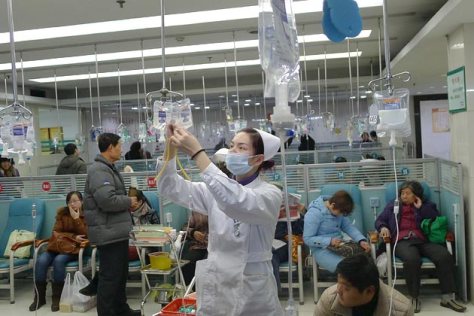
I live in China. This year, like every other, people with severely compromised immune systems were and are suffering from pneumonia. In early January 2020, in Wuhan, China – a place with dreadful air quality—hospitals started receiving patients.
In fact, for most of November, all of December, and most of January, the air quality index (AQI) was so bad that local governments regularly issued standard health warnings due to high levels of particulate matter. (At my school in Shanghai, if the AQI is over 150, children are cannot play outside. This is based on government advisories.)
And please be aware, far from hiding the problem, government officials in China at the regional and national level, readily provide daily and historical reports of the air quality index, noting particulate matter (PM2.5) and more. Thus we can track data for Wuhan — and most other large cities and urban areas — for the past six years.
Unsurprisingly, those diagnosed with severe forms of COVID-19 are the elderly and the immunocompromised. Additionally, people who have a host of pre-existing conditions are at higher risk. (NEJM March 30th, 2020). The Boston-based non-profit, Health Effects Institute, says anywhere from 500,000 to 1,250,000 Chinese die due to air pollution alone each year. (see pages 11-13). But the question discussed in this report is,
“When people have pneumonia or other respiratory difficulties, what are the best treatment protocols?”
Continue reading: China Cures Coronavirus with Vitamin C
 What's happening?